A picture held me captive
“A picture held us captive. And we could not get outside it, for it lay in our language and language seemed to repeat it to us inexorably.”
~Ludwig Wittgenstein
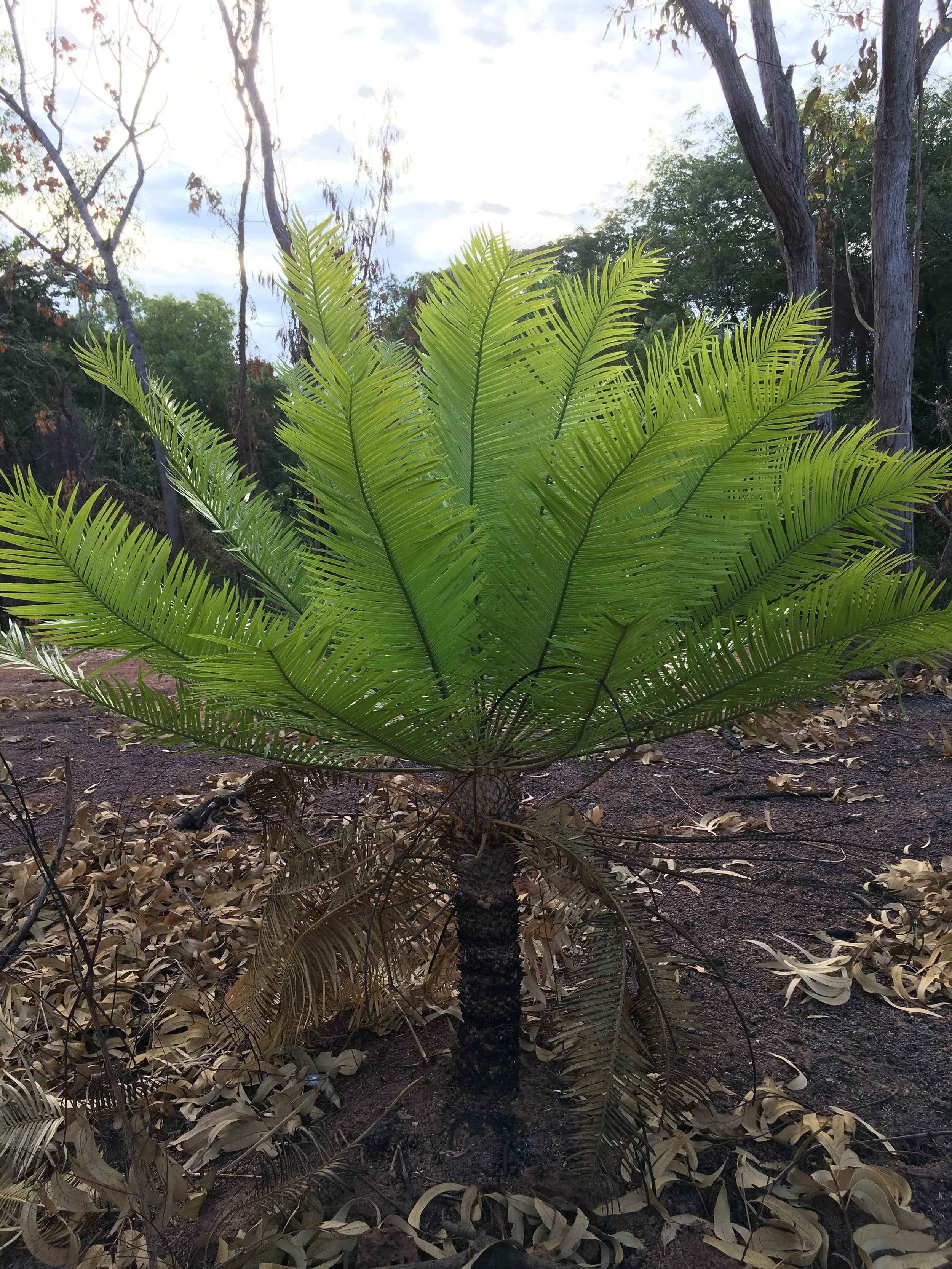
Tree frog green: that was the colour of cycads in January. Unfurling like prehistoric fountains from crumbed-rust dirt, they stayed fresh under the blazing sun. At night, wobbly ceiling fans would half-heartedly whip syrupy air into nearly cool breezes while geckos cack-cackled in corners, and the Bush Stone Curlew wailed. Carpentaria Palms clawed over rooves as dark air oozed between louvres, brushing the antennae of cockroaches en route to their nightly feed. Air-conditioning was rare. When rain finally broke from the clouds, the ground sizzled like a frypan under a tap, frogs redupping so loudly you couldn’t hear someone talking in the same room. From the second the boiled-blanket slap of tropical humidity greeted me at Darwin’s airport with no walls, I was unmoored.
Raised on an imaginative diet of four-seasoned woods, solid-walled houses and cloaked, clear-speaking heroes, I’d managed to overlay such scenes onto our old home of Melbourne, a city built close[ish] to the clime and image of Empire, but they made no sense here.
To overlay is to compare, and I was, like most of us, an incessant comparer. Like fitting a tracing to an original image, I sought to fit what I saw onto the framework of what I’d seen, whether via my own eyes or those of others. I saw beyond the sun’s white orb to fusioning Hydrogen atoms held in check by gravity, thanks to generations of physicists. I saw the lack of women in academia as a collision with the ‘glass ceiling,’ thanks to sociology articles. And—most strongly—I saw my day-to-day puzzle of a life through the lens of scenes in fiction. I was Jane Eyre, supremely self-reliant in a world that didn’t care; the boy down the road was a Eustace Scrubb; and science was over-reaching, so the robots might learn our worst habits—kudos for prescience, Asimov. “Scenes and characters from books,” wrote C. S. Lewis in An Experiment in Criticism, provide readers “with a sort of iconography by which they interpret or sum up their own experience.” Seeing in terms of what we’ve seen is a sort of orientation.
Stories, wrote Lewis, allow us “to see with other eyes, to imagine with other imaginations, to feel with other hearts, as well as with our own.” Our emotive response to good stories expands our perspectives and imprints on us a vision of the good and the beautiful that lifts our aspirations of how we could be. Russell Kirk, not often name-checked these days, writes in the The Moral Imagination that “great” stories (he references them 15 times) “teach us what it means to be genuinely human,” feeding our moral imagination that then “guides us upwards towards virtue and wisdom.” No longer just reliant our own “brief and confused” life experience or by “direct moral didacticism” that prescribes behaviour, we are also inspired by recollections of stories we have encountered. Jessica Hooten-Wilson, in The Scandal of Holiness: Renewing your Imagination in the Company of the Literary Saints, argues in terms of holiness, writing: “when we read stories of holiness, we live vicariously through those stories, then we body them forth in our reality.”
Except I found then, as now, that nearly all the “great,” “holy,” or even just the good, oft-recommended stories, are drenched in northern hemisphere imagery and culture. Over and over, settings so very different to my day-to-day experience lurched into the foreground on auto-compare and I became semi-blind to models of “virtue and wisdom” or “holiness” to which I should aspire. Comparison quickly becomes desire, as Girard warned us, and instead of a desire to be different or better, I desired my situation to be different. The imprinting spell was broken.
The culture of Europe and North America seeps into the books that were and are being recommended to me. Forests, mountains, winters, Americanisms, kings and jerkin-clad woodsy animals had colonised my imagination. And at the end of the day when I retreated to the safe, if overthinking, place of my mind, I wanted the air to be cool, the Carpentaria palms to turn autumn red and the bluebells to herald spring while I toiled by the hearth. Instead of cultivating a healthy moral imagination that aided my living well in my own world, reading had made me prone to Lewis’s “morbid castle building” where I sought escape. My orientation yawed. Lewis (always Lewis) knew those vicarious eyes of his hadn’t seen everything, that “even the eyes of all humanity are not enough.” Sometimes we need to use our own to get our bearings.
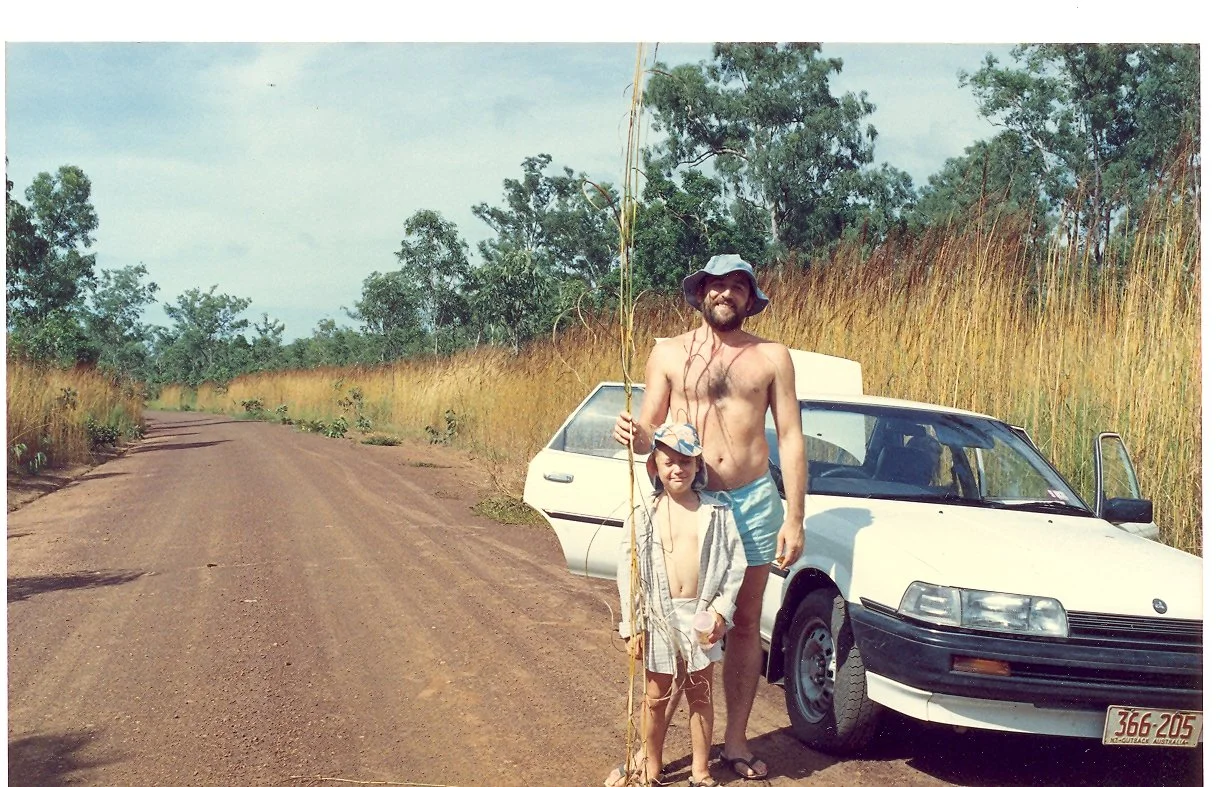
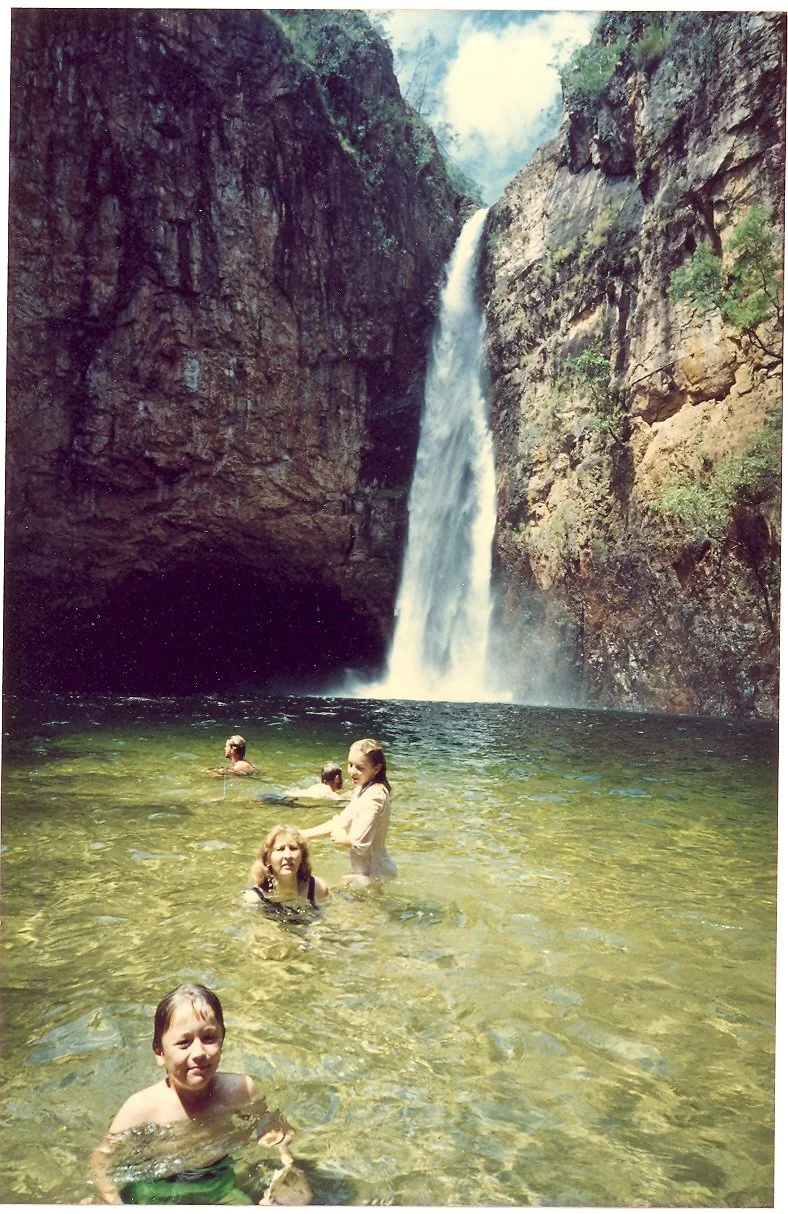
Perched on the northwest coast of the Top End—that top third of the Northern Territory that juts towards Indonesia—Darwin is closer to Asia than it is to any Australian city. Aboriginal and Torres Strait Islander people have inhabited the area that is now termed the Northern Territory for over 60,000 years and still make up more than one third of the population—an order of magnitude higher than southern states—but Darwin was a young town. Initially unwanted then twice demolished: first by Japanese bombs in 1942, then by Cyclone Tracy in 1974, it kept growing back but never quite the same, with a population always transient, like some morphing tropical fungus. In 1990, Mum, Dad, my brother, Ben, and I moved 3500km northwest to live there.
The seven-corded year was rather more involved than The Wet and The Dry that Mrs B, my Year 5 teacher in Melbourne, had told me about. I had also heard of the Build up, Dalirrgang, and Octobers did feel like a build-up to losing the plot. Cauliflowering thunderheads hung over afternoons; jostling water molecules forced skyward, only to plummet back down when their dollopy weight overcame updraft strength. My body craved the freshness of an Old World babbling brook, but crocodiles and deadly jellyfish lurked in the brackish, non-brook-like water. Patchy scrub and 2 metre-high speargrass provided little shade from ‘summer’ sun that lasted all year and steamed you soggy with humidity for more than half that year. Even my books couldn’t take it. Those precious books were being colonised, dark hyphae rotting them back to the ground from where their pages had first come, like all the towels and clothes.
Australian literature existed and, in time, I found it. My shelves became a mish-mash of Aussie youth and adult fiction with plenty of off-Earth set science fiction from around the world thrown in: Miles Franklin, Robin Klein, Tim Winton, Isaac Asimov, Arthur C. Clarke, Joan Lindsey, Patrick White were a few. (I was still, you see, very much embedded in white Australia). In Winton’s “dreamy briny sunshine” of his sixth novel, Cloudstreet, I found a somewhat effective antidote for autumn worship. I had never seen hillsides of red in a land of muted non-deciduous bushland. I had seen plenty of “dreamy briny sunshine,” and that someone had set within it a story that was deep and beautiful and full of Hooten-Wilson’s “holy exemplars” restrengthened those emotive connections to literature I had been losing. When the Melling daughters wrangle through an adolescence marred by poverty in their run-down Wilgawa home of Klein’s All In The Blue Unclouded Weather, or when Sybilla craves, like Jane Eyre, a space for her brain in a world where women were consigned to expect little “oil for the lamp of their existence,” in Franklin’s My Brilliant Career, I could see the character through the scene.
The stories through which we orient our lives and develop moral frameworks are not just fictional. Rather, to comprehend our life and our place in history is to see it as narrative.
Europeans entered Australia under an overarching narrative of European superiority. By declaring Australia Terra Nullius (land belonging to no one), Indigenous narratives were relegated insignificant. Though mission may have been another narrative in some well-intentioned missionary eyes, mission, as Meredith Lake articulates in The Bible in Australia: A Cultural History, was “often compromised by the agenda to civilise as well as Christianise,” and the Bible “arrived with the cultural products of its long history in Europe, including the form of the book.” The story of evangelism became entangled with the story of conquering and Europe, causing much Indigenous suffering as a result.
While many great stories transcend culture, plucking the natural frequency of our human souls and setting off a resonance of “Yes! That is how life is!”, I also needed local stories, those in which I could see my own culture and place reflected—the good and the beautiful can be found here too! Tim Keller once related how a black friend complained to him, “The thing that bugs me about white people is they don’t seem to think they have a culture.” [1] To which Keller responded, “What are you talking about?” before immediately realising he’d put his foot in it. I empathise with the frustration towards those in a replicating culture not seeing their culture as a culture; it just is. Those readers embedded in northern hemisphere majority cultures regularly seem unaware of the distraction of culture or setting.
Literature in Australia boomed in the 1980s and 90s. In Winton’s words, the “cultural cringe” died, and authors stopped feeling “compelled to ape the accents of their betters from another hemisphere.”2 The situation then and now is certainly better than at the turn of the 20th century when Henry Lawson wrote in an 1899 essay, Pursuing literature in Australia:
“My advice to any young Australian writer whose talents have been recognised would be to go to steerage, stow away, swim and seek London, Yankeeland or Timbucktoo rather than stay in Australia till his genius turn to gall or beer.” [2[
But Australia is big. Part of the reason I was shocked into recognition of my hijacked imagination in 1990 was because the Northern Territory is so different to where 95% of Australian’s lived (and still live) even if it comprises nearly 20% of Australia’s land area. Now I make an effort to read Northern Territory and far north Australian writers.
To argue for representative stories is not to argue all such stories are “great.” I’ve often heard the argument that the Western Canon is exclusive, but any canon must be exclusive, by definition. Not everything can be great. The real question is: have we checked everywhere? John Michael Colon, in his essay, On the End of the Canon Wars, in Point Magazine writes:
“What had to be done, but wasn’t, was to develop a truly global canon—one that could transcend the provincialism of the so-called Western mind and yet remain faithful to that aspiration, integral to the greatest of the old Great Books programs, of rooting a democratic culture in what Matthew Arnold called “the best which has been thought and said.”
I agree. Dostoevsky, just as the song goes, changed my life, but I wish we could also look away from the standard recommended book lists. Lewis wrote way back in 1961 that “The list of approved authors grows absurdly small.” We should be careful it doesn’t grow even smaller. Growing a canon is no small job. It can’t, writes Colon, be “hastily thrown together.” Since the literati hadn’t and haven’t done it for me, I was and am left with the daunting task of filtering my own books. (Recent local efforts, for example the Macquarie PEN Anthology of Australian Literature, have been highly controversial and not particularly useful).
Maybe that’s the way it should be. To be inspired by the established classics doesn’t mean we can’t also read and be rooted by local stories, and, when our fossicking reveals a gem, we can gently add it to our classics shelf. I’ve nowhere near read all Australia has to offer, but I’ve been enriched by many good stories. I’m still learning to not always reach for the northern hemisphere book.
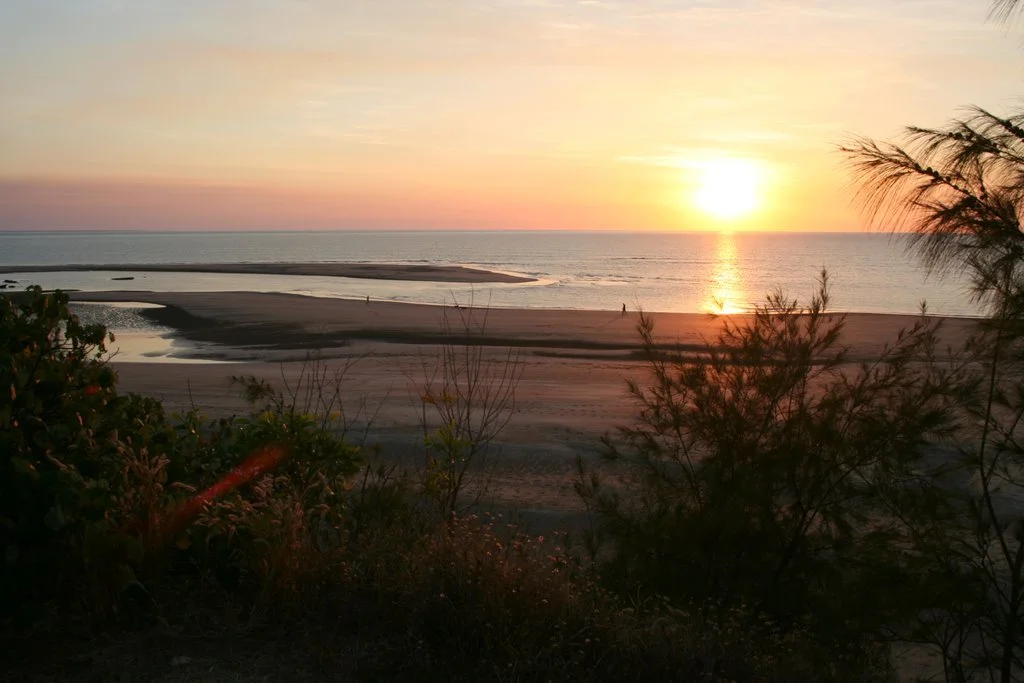
The third house we lived in was near the beach. Scrubland over the road gave way to a ribbon of rainforest then Casuarina pines lined siltstone beach cliffs: ochre scallops surveying the 8 metre tides. “Awful!” said my visiting friend. “Hot, muddy and desolate.” But I was coming to disagree. Hot and muddy, yes, but spacious as well as desolate. I would backflip over sand, hemmed alone into a triangular cove when the tide swelled, before scrambling up the cliff when waves lapped its base. Night by night, gliding through streamers of grass and yellow-flowered kapok trees on the way home, I’d stop in a clearing where I could escape the day. Spreadeagled on dirt in a thick tropical night, looking up, I slowly became just one more person who lived here, who learnt here, who remembered here.
Now, the dirt holds Ben, the rest of us sit above it, and the stars sit above all. My bookshelves have Shakespeare and Brönte next to Winton, Wood and Heiss guarding against “morbid castle building.” Across the Top End, waves push forward and back like they’ve done since the ocean surged up through the Arafura Sea 18,000 years ago. History is documented in layers of sediment and in paintings on the walls of overhangs fringing the coast, in the aural tradition of local people and now in my memory too. The Top End’s a real place; it just hasn’t been mapped out in tomes of old books. Real places often aren’t.
References
1. Keller, Timothy, Sermon: Hope, Race and Power, preached at Redeemer Presbyterian Church, 25 April, 2004. Downloaded January 2019 from gospelinlife.com
2. Quoted by Schultz, Julianne in A Brilliant Career on the Edge, Griffith Review, 10 Oct, 2009
3. Quoted by Vanovac, Neda in Why doesn’t the tropical north produce more agriculturally? ABC News, 31 Jul 2018
4. Baker, Jordan, Old curriculum chapter reopens as history wars erupt, Sydney Morning Herald, Nov 7, 2021